

Men's vs Women's Haircuts: What's the Real Difference?
Explore the real technical and conventional differences between men's and women's haircuts to make a more informed choice about your next visit.
The distinction between men's and women's haircuts is one of the most commonly assumed and least commonly examined divisions in the hair industry. Clients navigate to a barber or a salon partly based on this distinction,…

A Question Worth Asking Properly
The distinction between men's and women's haircuts is one of the most commonly assumed and least commonly examined divisions in the hair industry. Clients navigate to a barber or a salon partly based on this distinction, pricing is often structured around it, and the language used to describe services reinforces it at every turn. Yet when the actual technical elements of haircut execution are examined closely, the boundary becomes considerably less clear than the industry's conventions suggest.
Understanding where the real differences lie, and where the perceived differences are largely a product of convention rather than technical necessity, is useful for any client trying to make sense of a market that can feel unnecessarily divided. It is also relevant for anyone who feels that the standard offerings within their assigned category do not serve them particularly well and who is wondering whether there is a more useful way to approach the decision.
This is not an argument that the distinction between men's and women's haircuts is meaningless. In many respects it reflects genuine differences in the techniques most commonly applied and the styles most commonly requested. But those differences are more nuanced than the binary framing suggests, and appreciating the nuance produces better results both for clients who stay within convention and for those who want to work outside it.
Technical Differences in How the Cuts Are Executed
Clipper Work and Barbering Technique
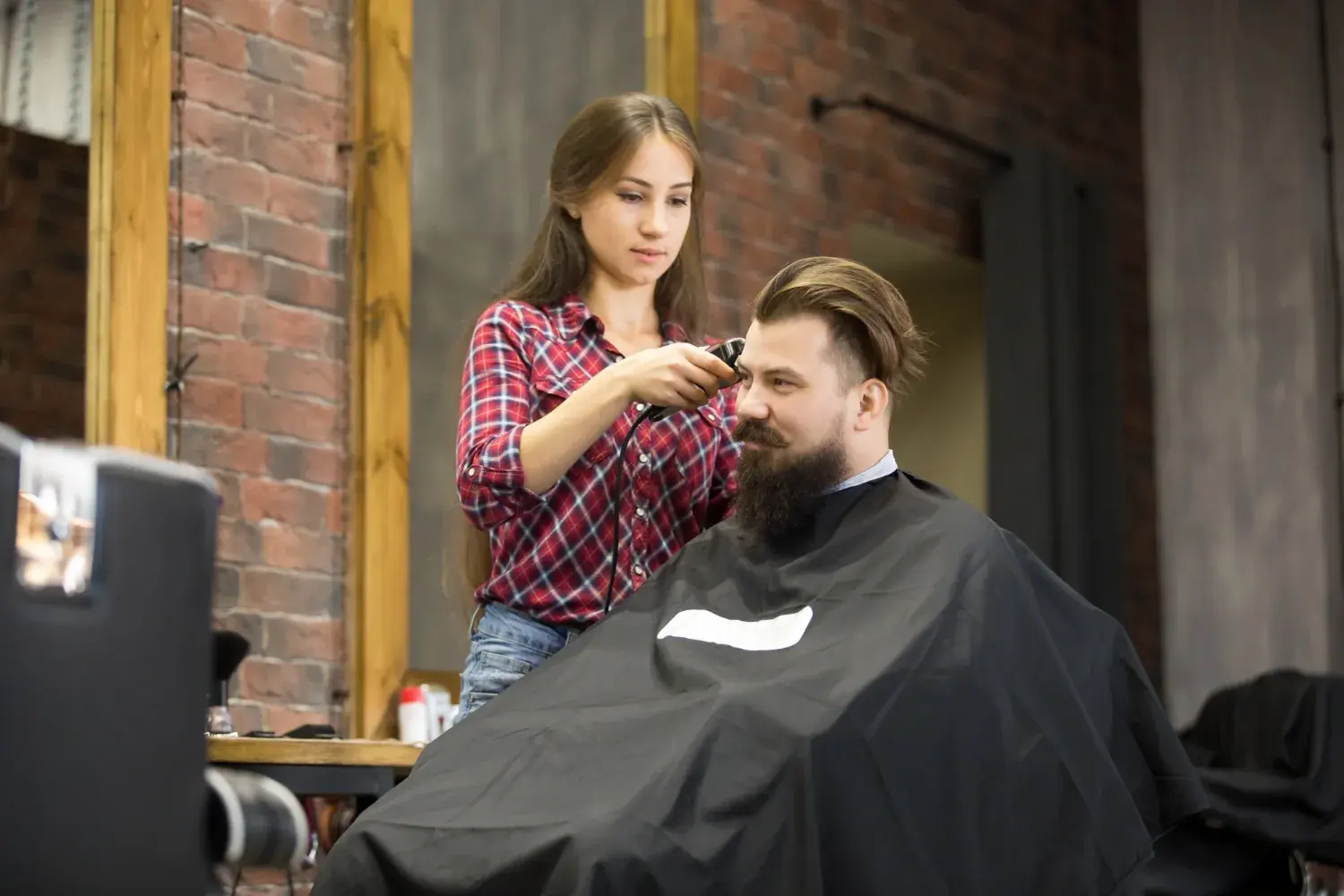
The most concrete technical difference between traditional men's and women's haircuts is the use of clippers. Barbering, which is the trade most associated with men's grooming, developed around the use of clippers to manage short back and sides and to create the clean, close finishes at the neckline and around the ears that short male styles typically require. The technical vocabulary of the barber, including terms like taper, fade, blend, and clipper-over-comb, describes a set of techniques centred on short hair management that has historically been less central to salon training focused on women's styles.
Scissor-only cuts, by contrast, form a larger proportion of women's haircut training and are the dominant technique for longer styles across all hair lengths. The ability to create precise weight lines, to execute graduation through scissor work alone, and to use point-cutting and texturising techniques to manage density and movement is part of the core technical skill set of salon training. Most experienced hairdressers are competent in both scissors and clippers, but the emphasis in training and the frequency of use in practice has historically varied between the two professional contexts.
Perimeter Lines and Interior Construction
Women's haircuts have historically placed significant emphasis on the perimeter line, meaning the shape created by the outer edge of the cut, as the primary determinant of the style's character. The blunt bob, the layered cut, the long one-length style: all of these are defined largely by their perimeter shape. Interior construction, such as layering and graduation, is used to manage weight and movement within the outer shape rather than to define the style in isolation.
Men's haircuts, particularly at shorter lengths, place more emphasis on the construction of the interior as the primary source of the style's shape. A fade, for example, is entirely a construction technique: it describes the graduated transition from shorter to longer hair across the sides and back of the head. The perimeter line is less defining in these styles because the hair is too short to create a strong perimeter effect. As men's styles get longer, however, the distinction diminishes, and the technical approach begins to converge with the scissor-focused techniques of salon cutting.
Neckline Finishing
Neckline treatment is one of the clearest practical differences between the two cutting contexts. Traditional men's haircuts finish with a clean, defined neckline, created either by clipper work or by razor, that provides a sharp edge against the skin. This finish is expected and visible, and it tends to grow out in a way that is noticed relatively quickly, contributing to the shorter average interval between men's haircuts compared to women's.
Women's cuts more commonly use a natural neckline that grows out less obviously, blending with the surrounding hair rather than creating a defined edge against the skin. This is not a universal rule: some women's styles, particularly shorter cuts like pixie styles and undercut variations, use a finished neckline comparable to men's cuts. But as a generalisation, neckline treatment is one of the areas where the technical approach has historically differed most consistently.
Where the Distinction Is Largely Conventional
Beyond these genuine technical differences, much of the distinction between men's and women's haircuts is a matter of convention rather than technique. A layered bob is not technically a women's hairstyle; it is a cut that happens to be more frequently requested by women and more frequently marketed in that context. A textured crop is not technically a men's hairstyle; it is a cut that reads differently when framed within a salon offering versus a barbershop offering, but the underlying technique is largely the same.
Pricing is one area where convention creates a genuine disparity that is worth examining. Women's haircuts are priced higher than men's in most salons, based partly on the assumption that they take longer and involve more complex technique. This generalisation holds in many cases: a long, layered women's haircut involves more physical work than a short clipper cut. But a women's pixie cut and a men's textured crop may take comparable time and skill to execute, yet be priced very differently based on the gender framing of the service rather than its actual complexity.
The trend toward gender-neutral pricing, based on hair length and service complexity rather than client gender, reflects a more technically honest approach to the question and has been adopted by a growing number of progressive salons. Whether or not a specific salon has adopted this model, clients who are unsure whether a barber or a salon is the right choice for a given style are often best served by asking which environment has more experience with the specific cut they want rather than defaulting to the conventional gender assignment.
Choosing the Right Environment for Your Haircut
The practical implication of all of this is that the choice between a barbershop and a salon, or between a men's stylist and a women's stylist, should ideally be made based on who has the most relevant experience with the specific style being requested rather than on a binary gender assignment. For short styles with significant clipper work, an experienced barber will typically have more regular practice with the relevant techniques. For longer styles with significant scissor work, a salon stylist will typically be better positioned.
For styles that sit in the middle, including textured crops, longer men's styles, and shorter women's styles, the distinction is less clear and the quality of the individual stylist matters more than the type of establishment. The most useful question is not whether to go to a barber or a salon, but whether the specific person performing the cut has done this cut many times before and understands the technical requirements of the result being sought.
For clients who want access to expertise across the full range of lengths and styles, a professional team offering both ladies and mens hair cuts removes the need to make a binary choice and provides consistent quality regardless of which style is being requested.
Conclusion
The distinction between men's and women's haircuts is real in some technical respects and largely conventional in others. The most reliable guide to a good result is not which side of the gender divide a service falls on, but whether the stylist performing the cut has the specific skills and experience to deliver it well. If you are ready to book a cut with a team that focuses on quality over convention, get in touch and we will help you find exactly what you are looking for.
Ready to book your next appointment?
Every visit to TopOne Richmond starts with a one-to-one consultation, so your cut, colour or treatment is tailored to your hair, your features and your routine.
Visit us in Richmond
TopOne is a hair salon in Richmond at 31 The Quadrant, TW9 1DN. A short walk from Richmond station, open Tuesday to Saturday.
More from the blog
31 May 2026
The Best Haircuts for Thin Thick and Curly Hair
Discover the best haircuts for fine, thick, and curly hair types with expert guidance on which styles work and which to avoid for each texture.

31 May 2026
How Often Should You Get a Haircut? A Complete Guide
Find out exactly how often you should get a haircut based on your style, hair type, and condition with this expert complete guide.

31 May 2026
Low-Maintenance Haircuts That Still Look Stylish
Discover low-maintenance haircuts that look stylish with minimal daily effort, chosen for your hair type, face shape, and lifestyle.
Ready to book your next appointment?
At TopOne Hair & Beauty Richmond, we believe in results that last. Not just on the day, but in the weeks that follow.